


Why Value Chain ESG Disclosures Matter
As Environmental, Social and Governance (ESG) expectations continue to rise, companies are facing greater scrutiny not only over their own sustainability practices, but also over the environmental and social impacts across their value chains. Suppliers, vendors, customers and other business partners can represent a significant share of a company’s ESG impacts and risks, making reliable value chain data increasingly important.
The Securities and Exchange Board of India (SEBI)’s Business Responsibility and Sustainability Reporting (BRSR) framework has brought greater focus to ESG reporting beyond a company’s direct operations. Under the revised framework, value chain ESG disclosures are applicable to the top 250 listed entities by market capitalisation on a voluntary basis from FY2025-26, with disclosures centred around significant upstream and downstream partners identified through specified reporting thresholds. Assessment or assurance of these value chain disclosures is also voluntary, from FY 2026-27.
The focus therefore shifts to two key questions: which value chain partners fall within the disclosure scope, and how can the relevant ESG data be collected from them?
Identifying the 2% Value Chain Partners
The approach for identifying value chain partners has evolved since the introduction of the framework in 2023. The original framework identified value chain partners based on cumulative coverage of 75% of purchases and sales by value and was applicable on a comply-or-explain basis. However, in 2025, SEBI revised the framework, introducing a 2% individual threshold for identifying value chain partners and making value chain ESG disclosures voluntary for the top 250 listed entities by market capitalisation from FY2025-26.
A company’s value chain typically encompasses both upstream and downstream partners. Upstream partners may include suppliers, vendors and other entities from whom the listed entity purchases goods or services, while downstream partners may include customers, distributors and other entities to whom the listed entity sells goods or services. Under the revised framework, upstream partners that individually account for 2% or more of total purchases by value and downstream partners that individually account for 2% or more of total sales by value fall within the value chain disclosure scope. Where a listed entity chooses to provide value chain ESG disclosures, it is expected to disclose the percentage of total purchases and sales covered by the partners included within the reporting scope.
Illustration: How the 2% Threshold Works
Consider a listed entity with total purchases of ₹1,000 crore during FY2025-26. Its eight largest suppliers are shown below; the remaining ₹140 crore is spread across many smaller suppliers, each below 2% of purchases.
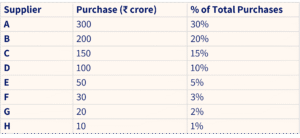
Suppliers A to G individually account for 2% or more of total purchases and therefore fall within the disclosure scope. Supplier H, however, accounts for 1% of purchases and therefore falls below the threshold.
Furthermore, SEBI permits a listed entity to limit its value chain disclosures to partners collectively covering 75% of purchases and sales by value. In the example above, Suppliers A to D together account for 75% of purchases (30% + 20% + 15% + 10% = 75%). Therefore, the listed entity may choose to limit its disclosures to these suppliers while still achieving the specified coverage level.
The same principle applies downstream, where customers, distributors or other partners individually accounting for 2% or more of sales by value fall within the disclosure scope. Disclosures may similarly be limited to partners collectively covering 75% of sales by value.
Together, the 2% threshold and 75% coverage criteria help focus reporting on the most significant value chain partners.
Collecting the Right ESG Data
Once the relevant value chain partners have been identified, the next step is determining and obtaining the ESG information required to support the listed entity’s value chain disclosures.
Under SEBI’s framework, value chain ESG disclosures are aligned with the BRSR Core framework. Accordingly, relevant BRSR Core KPIs are reported to the extent attributable to the listed entity’s business relationship with the value chain partner.
The information collected from value chain partners may therefore span a range of environmental, social and business-related indicators, including:
- Environmental indicators: greenhouse gas (GHG) emissions, energy consumption, water use and waste generation.
- Social indicators: health and safety performance, employee wellbeing and gender diversity.
- Business conduct indicators: fairness in engaging with customers and suppliers, including data privacy breaches.
This information can be collected through a standardised questionnaire sent to the identified value chain partners. Furthermore, clarifying definitions, reporting periods and methodologies can improve consistency across responses. The focus is therefore on obtaining information relevant to the listed entity’s value chain disclosures, rather than collecting a value chain partner’s entire ESG dataset.
Conclusion – From Disclosure to Visibility
As value chain ESG expectations continue to evolve, value chain disclosures can help organisations look beyond their direct operations and gain deeper insight into the sustainability performance of key suppliers, customers and other business partners.
By identifying significant upstream and downstream partners through the 2% threshold and collecting relevant BRSR Core-aligned information in a consistent and comparable format, companies can develop a more complete picture of ESG impacts across their business ecosystem.
Companies that build visibility across their value chains today will be better positioned to understand, manage and respond to the ESG risks and opportunities of tomorrow.
Author – Kushaan Mitra (Research Associate)