


Business implications for global capability centre strategy in India
Haryana’s Global Capability Centre Policy 2026 is more substantive than a generic investment announcement. The policy was notified effective 27 May 2026 and will remain in force for five years from the date of notification or until superseded by a new policy/amendment. It sets clear entry thresholds, location-linked incentives, employment-linked benefits, and R&D support measures that indicate a deliberate attempt to make Haryana a competitive GCC destination, particularly for higher-value and scalable operations.
Policy highlights at a glance
Eligibility thresholds
- Minimum employment threshold: 100 employees on payroll or contract with ESI/PF numbers within 3 years of commencement of operations.
- Large unit threshold: INR 125 crore fixed capital investment, or INR 50 crore with 500 direct employees.
- Mega unit threshold: INR 400-700 crore fixed capital investment, or INR 125 crore with 1,250 direct employees.
- Ultra-mega threshold: INR 1,500-6,000 crore fixed capital investment.
Existing Unit Eligibility:
- Existing GCC units expanding operations on or after 1 January 2026 are eligible
- Investments made in the one-year period preceding policy notification qualify for retroactive benefits
Human Resource Development and Night Shifts for Women
- Employment generation subsidy: % of average gross monthly salary for 10 years (requires 1+ year continuous employment, valid ESI/PF)
- Local employment threshold: >15% of total workforce
- Floor subsidy: INR 48,000 p.a. when average monthly salary < INR 48,000
- Night shifts for women: Three shifts permitted including night shifts, with mandated transportation and safety provisions
Innovation and R&D Support
Job-readiness support reimburses 50% of a 6-month stipend, up to INR 15,000 per month for 50 interns per annum.
For DSIR or CSIR-recognised R&D centres, capital subsidy is available at 50% of eligible capital cost, up to INR 10-50 crore, to be distributed in 5 annual instalments. Operational cost reimbursement benefit of 50% upto 2 crore per year
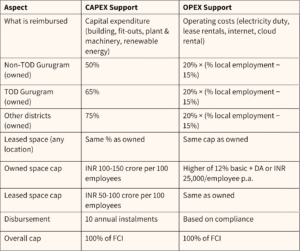
CAPEX vs OPEX Support
What stands out in the policy design
The policy is notable because it does not rely on a single headline incentive. Instead, it combines entry thresholds, location-based capital support, operating cost reimbursements, employment-linked subsidies, women-specific provisions, and innovation incentives into a layered package. This is closer to how new age GCC policies are typically structured: the business case is built across setup, scale, and sustained operations rather than around a one-time benefit.
Another important design feature is the location differentiation. Haryana is effectively signalling that it wants to balance the attractiveness of Gurugram with stronger relative support in other districts, explicitly prioritising investment in non-Gurugram districts to promote balanced regional development and position Tier-2 cities such as Panchkula and Hisar as GCC destinations. That has implications for companies evaluating whether they need immediate access to the NCR corporate ecosystem or are willing to trade some of that proximity for stronger incentive economics elsewhere in the state.
The policy also explicitly addresses women workforce participation through night shift allowances, enhanced subsidies, and safety/transportation provisions, making it more progressive than many earlier industrial policies.
What businesses should assess
For businesses, the policy should be assessed on three levels.
- First, there is threshold fit: whether the planned investment and employment model aligns with the policy’s eligibility structure.
- Second, there is commercial fit: whether the CAPEX, OPEX, and employment-linked benefits are material enough to change the economics of the proposed GCC.
- Third, there is execution fit: whether the company can realistically access, document, and sustain compliance with the benefit conditions over time.
This is particularly relevant for firms planning phased expansion. Since benefits are tied to defined investment and employment thresholds, the sequencing of hiring, fit-out, and operational launch may materially influence the eventual value capture. In other words, policy value here is not just about where a GCC is located, but also how the rollout is planned.
Market implications
The policy strengthens Haryana case as a GCC destination for organisations looking beyond traditional metro concentration. Its combination of NCR adjacency, enterprise density, policy-backed support, specific R&D provisions, women-specific workforce provisions, and streamlined facilitation through the AI-enabled Single Window 2.0 (Intelligent Investment Facilitation Portal) established in Gurugram for streamlined approvals, land allocation, and incentive access makes it especially relevant for companies building more specialised and higher-value centres rather than simple cost-arbitrage units.
At the same time, the policy also raises the competitive bar for companies comparing Indian states. The decision is likely to turn less on headline visibility and more on the detailed interplay between incentive value, location suitability, talent access, and implementation ease.
Closing perspective
For organisations assessing India-based GCC expansion, the Haryana policy is best read as a location strategy input rather than a standalone decision trigger. The policy becomes most meaningful when tested against the intended operating model, talent design, timeline, and long-term scale ambition of the proposed GCC.
That is also where a more measured advisory lens becomes useful: not to oversell the policy, but to evaluate whether it genuinely improves the business case compared with other options. A well-grounded market entry or expansion plan should therefore connect policy interpretation with execution realities such as entity structuring, hiring ramp-up, real estate planning, and governance design.
Pierag Consulting supports organisations with GCC expansion by helping translate policy incentives into a workable business case, operating model design, and execution roadmap across feasibility, setup, and scale phases.