


Why people, process and technology decide whether your GCC succeeds
If you are planning a GCC in India, where is most of your planning time going right now?
If the honest answer is entity registration, RBI filings and state incentives, you are not alone. It is also where most guides on setting up a GCC stop. This article is about everything that comes after.
India’s GCC story has outgrown its original script. According to the Nasscom–Zinnov GCC Value Orbit report released in July 2026, the country now hosts 2,117 GCCs across 3,728 units, employing about 2.36 million professionals and generating an estimated US$98.4 billion in FY26. [1]
The centres themselves have changed even faster than the numbers. The first generation was built to do the same work for less. Today, 96% of GCCs set up since FY21 launched with a product or portfolio mandate, and centres are reaching maturity in under five years instead of five to ten. [1] [2] The question for most boardrooms is no longer whether to build in India, but how to build a centre that keeps adding value long after launch.
Where the effort really goes
Entity set-up, registrations and compliance must be done right, and on time. But across the full journey from first business case to a mature, value-creating centre, they are a small slice of the work.
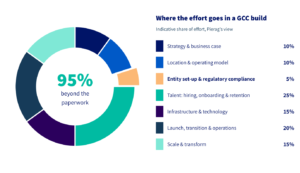
Indicative split of effort across the GCC lifecycle, based on Pierag’s experience. Actual shares vary by scale, functions and operating model.
That 95% comes down to three pillars: people, process and operations, and technology. Each has changed more in the last five years than in the decade before it, and each is where GCCs most often succeed or stall.
1. People- From hiring at scale to building leadership, depth and belonging
A GCC is only as strong as the people who choose to build their careers in it.
How it has evolved
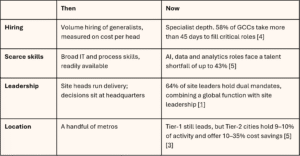
What it takes today
Lead with leadership. The India head is the most important hire of year one, and the right profile depends on the mandate: an operator to stabilise, a builder to scale, or a transformation leader to take on global ownership. Hiring them before bulk recruitment sets the tone for everyone who follows.
Make location a talent decision. Rent and incentives matter, but talent depth decides where a centre can grow. Many organisations now anchor scarce, senior skills in a Tier-1 hub and scale in a Tier-2 city, where attrition pressure and costs are lower.
Hire for depth, build for breadth. The skills in highest demand are generative AI (66% of GCCs), data science (58%) and AI/ML engineering (50%). [4] No hiring plan can buy all of that on the open market. The strongest centres pair specialist hiring with campus and university pipelines and structured upskilling.
Retain through belonging, not just pay. People stay where they can see a future. That means visible career paths into global roles, sponsors at headquarters, and onboarding that transfers culture, not just process. A team that feels like an offshore unit behaves like one.
Where centres go wrong
- Hiring at speed before the mandate and roles are clearly defined
- Treating the India team as capacity rather than as part of the firm
- Budgeting for headcount but not for the time it takes to find and keep the right people
Ask Yourself:
- When does your India leader join, and with what mandate?
- Which roles must sit in a Tier-1 hub, and which can scale in a Tier-2 city?
- How will an employee in India see their next two career moves inside the global organisation?
Who at headquarters is accountable for making the India team feel like one team?
How Pierag Helps?
Workforce planning and role design, leadership and specialist hiring, campus recruitment, compensation benchmarking, onboarding and training, and engagement programmes that build a one-firm culture. To date, Pierag has hired 1,500+ professionals for client GCCs.
2. Process and Operations- From lift-and-shift to end-to-end ownership
Moving work to India is easy. Making India own it is the real test.
How it has evolved
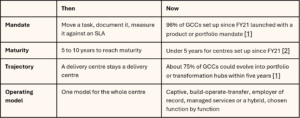
What it takes today
Decide what to own. Not every function belongs in-house on day one. Work that is strategic, IP-sensitive or heavily regulated tends to belong in the captive; standardised or volatile work can often be run by a partner while the centre stabilises. The answer usually differs function by function.
Transition with discipline. Knowledge transfer, documented SOPs, parallel runs and clear go-live criteria decide whether the business notices the move. Moving a broken process to India only moves the problem.
Govern for value, not volume. A steering committee with headquarters and India both at the table, clear escalation paths, and KPIs that go beyond cost: time to productivity, quality, and how much the centre owns end to end. Without this, centres drift into a staffing model.
Get the support engine right. HR, payroll, finance and accounting, procurement, administration and compliance rarely feature in the business case, yet they shape the day-to-day experience of every employee. They are often the first functions worth handing to an experienced partner.
Where centres go wrong
- Lifting and shifting processes before they are stable
- Treating governance as something to add once the centre is running
- Underestimating the support functions that keep the centre running
Ask Yourself:
- Which processes are core to your advantage, and which could a partner run?
- Do you stabilise processes before moving them, or move them and transform in India?
- Who owns each process end to end: headquarters, the India centre or a partner?
- What does success look like at 90 days, 12 months and three years?
How Pierag Helps?
Operating model design, operational readiness (HR, finance, payroll, procurement, SOPs and knowledge transfer), governance and KPI frameworks, and managed operations for functions such as finance and accounting, customer support and administration, backed by Pierag’s risk and compliance expertise.
3. Technology – From replicating the stack to building credibility
A new GCC is a rare chance to design technology right the first time.
How it has evolved
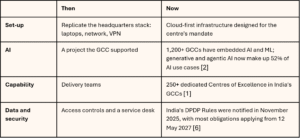
What it takes today
Mirror or leapfrog. A new centre can copy the parent’s stack for consistency, or use the set-up to adopt a cleaner, more modern footprint. Both are valid; the choice should follow the mandate, not habit.
Design security and data flows from day one. Parent security standards, India’s data protection law and the rules on moving data between India and headquarters all need to be built into the architecture. Retrofitting them later is slower and costlier.
Build AI into the operating model. Decide early where automation and AI will remove work and where they will augment it. That decision changes the roles you hire, the processes you design and the value the centre can claim.
Choose for adoption. The best tool is the one your teams actually use. Collaboration across time zones, simple workflows and good support matter as much as features.
Where centres go wrong
- Retrofitting security and data protection after go-live
- Buying tools before the processes they support are defined
- Running AI pilots with no clear owner or business outcome
Ask Yourself:
- Should the centre mirror your headquarters stack, or leapfrog it?
- Where will AI remove work, and where will it change the roles you hire?
- How will data move between India and headquarters, and is that design compliant on both sides?
- Which tools will your teams actually adopt?
How Pierag Helps?
IT infrastructure and endpoint set-up, security, access and business continuity, technology selection, and AI and automation through Pierag’s AI & Digital practice, with technology risk specialists to make the centre audit-ready from the start.
The pillars move together
A decision in one pillar changes the other two. Automating a finance process changes who you hire. Outsourcing customer support changes the process knowledge you keep. A Tier-2 location changes the collaboration tools you need. The centres that perform best are the ones where all three were designed together.
Pierag across the GCC lifecycle
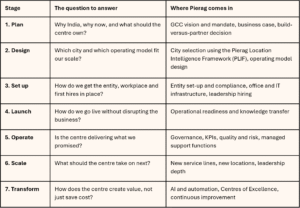
Pierag supports clients across all seven stages of a GCC, either end to end or at the stages where they need it most.
Quick check: is your GCC plan built for the 95%?
Tick the statements that are true for your plan today.
☐ We have a clear mandate for the centre beyond cost savings.
☐ Our India leader is hired, or the profile is defined.
☐ We have chosen our city based on talent depth, not just rent.
☐ We know which functions to own and which to partner on.
☐ We have a retention and culture plan, not just a hiring plan.
☐ Our technology and data set-up is designed for security and AI from day one.
☐ We have agreed how success will be measured in the first year.
Fewer than five ticks? You are not behind, but these are the conversations worth having before you sign a lease.
And the paperwork?
It still matters. A GCC needs the right entity, a clean incorporation, FEMA and RBI filings, labour and tax registrations, and a sound transfer-pricing position. State incentives can be material too: Haryana’s 2026 GCC policy is one example. Done well, this work is quick and predictable. It is the foundation, not the strategy.
Let’s talk about the other 95%
Whether you are weighing India for the first time, choosing between operating models, or looking to take an existing centre further, Pierag brings a consulting mindset, its own research and frameworks, and teams who have been doing this for years.
Every GCC starts with a different set of answers. Speak to our team and we will start with yours.