Artificial intelligence is no longer a fringe innovation topic or a limited pilot initiative. It has moved firmly into the enterprise mainstream, and the market conversation has shifted accordingly: from experimentation to scale, governance, operating models, and measurable value creation.
That shift matters because adoption is no longer the real test of maturity. Most enterprises today can access leading models, license copilots, launch pilots, and introduce AI-enabled tools into selected functions. Yet the presence of AI in the technology stack does not, by itself, improve business performance. The more important question is whether AI has been embedded in a way that meaningfully improves how work gets done.
This is where many enterprise AI programs begin to lose clarity. Attention often centres on model selection, tool comparisons, or the promise of the latest platform release. Those decisions are relevant, but they are not usually what determines long-term value. In practice, the more difficult and more consequential challenge is execution: defining where AI belongs within a business process, where conventional automation is more effective, where human judgment must remain central, and how all of it is governed at scale.
Recent enterprise experience has made this distinction increasingly visible. Many of the most instructive AI stories are not about whether the technology works in principle. Instead, they are about cost overruns, unclear returns, weak process fit, inconsistent usage, and the difficulty of scaling tools that were introduced without sufficient operational discipline. That is why enterprise AI strategy should not begin with access to technology. It must begin with the design of work.
Shifting the Focus: From Access to Execution
A more effective starting point is the business workflow itself. To build a grounded, impactful AI roadmap, leaders must step back from the technology and begin by asking critical diagnostic questions:
- Process Centrality: Which processes are genuinely central to our operational performance?
- Friction Points: Where do teams currently lose time to review, rework, handoffs, or fragmented information?
- Cognitive Demands: Which activities depend most heavily on pattern recognition, contextual interpretation, or complex exception handling?
- Value Leverage: Where would better support improve quality, consistency, customer experience, or the speed of decision-making?
These questions tend to produce a much more grounded roadmap than a technology-first approach. They also lead to an essential realization: not every business problem requires AI, and not every step within an AI-enabled process should be handled by AI.
Deconstructing the Workflow
Enterprise workflows contain distinct categories of work, and each category demands a different tool. Some steps are deterministic and governed by stable rules. Others are repetitive and process-driven. Some involve ambiguity, unstructured information, or complex contextual interpretation. Others require legal accountability, commercial judgment, or strict compliance oversight.
Treating all of these as the same kind of problem is one of the most common errors in enterprise AI design. Strong AI programs are rarely built by maximizing the amount of AI in a process; they are built by assigning the right capability to the right type of task.
The vendor invoice process offers a highly practical illustration of this multi-layered framework.
Consider a multinational enterprise managing thousands of global suppliers. Seeking a quick win, leadership deploys a generic, off-the-shelf AI co-pilot to automatically read and approve all incoming invoices. In reality, the initiative quickly derails. The generic AI hallucinates on standard tax fields because it does not understand the firm’s strict internal data boundaries. It wastes expensive computational power simply routing a PDF from a manager to a VP. Worst of all, it mistakenly approves a disputed, high-value transaction because it lacks the commercial context of an ongoing vendor lawsuit.
This failure occurs because the enterprise treats the entire workflow as an “AI problem.” In reality, to succeed, the process must be deconstructed into a layered operating model:
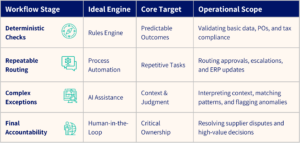
- Rules with Predictable Outcomes: Validating invoice data against purchase orders and tax requirements is entirely rule-based. A classic rules engine is the most cost-effective and reliable tool here.
- Automating Repetitive Tasks: Procedural steps, including routing approvals and updating ERP systems, are highly repeatable. Standard workflow automation is best suited to these status-based actions.
- AI Where Context and Judgment Are Required: AI becomes highly valuable during exceptions—unusual charges, incomplete documentation, or subtle inconsistencies. Here, AI can analyze unstructured supporting material, highlight anomalies, and assist a reviewer in narrowing down the issues.
- Humans When Accountability Counts: Human oversight remains strictly necessary where commercial judgment, regulatory sensitivity, supplier disputes, or high-value decisions require a level of accountability that cannot be delegated to an algorithm.
This layered operating model is far more effective than the blanket idea of “AI everywhere.” It respects the unique strengths of rules, automation, AI, and human expertise.
Custom Architecture vs. Generic SaaS
Because strategic enterprise workflows require this precise, multi-layered coordination, managing the handoffs between strict business rules, standard automation, and cognitive AI assistance requires a cohesive, tailored orchestrator. Generic, off-the-shelf software rarely has the inherent flexibility to stitch these four layers together seamlessly.
This raises a critical question for enterprise leaders: when is a standard platform sufficient, and when is custom development justified? The most effective standard operating procedure (SOP) relies on a simple distinction:
- Context Workflows (Buy/Standard SaaS): These are non-differentiating processes that every company handles similarly—such as standard payroll processing, routine expense categorization, or basic accounts payable routing. For these, standard, off-the-shelf platform tools are completely sufficient. There is no strategic value in reinventing the wheel.
- Core Workflows (Build/Custom Orchestration): These are the proprietary processes where an enterprise actually wins its market—whether that is an investment bank’s proprietary M&A valuation model, an consulting firm’s technical accounting expertise, or a multinational’s complex forecasting engine.
This challenge has become top-of-mind as adoption timelines compress. Research from the Wharton School and GBK Collective indicates that generative AI is fast-tracking into the core of the enterprise, with decision-makers increasingly shifting budgets from experimentation to integration.
Yet, as adoption accelerates, the gap between high-performing and average organizations becomes clearer. McKinsey’s research indicates that while AI use is now widespread, the ability to translate that use into actual business impact remains highly uneven. Crucially, high-performing organizations are far more likely to redesign workflows fundamentally to support this multi-layered reality, rather than simply overlaying AI onto existing, broken activity. Enterprise value is created not when AI is added on top of work, but when work itself is redesigned to use AI appropriately.
In specialized, “Core” environments, durable value typically comes not from buying another off-the-shelf license, but from configuring bespoke solutions that align perfectly with the unique operating model of the business.
Governance and the Power of Human Augmentation
To support this bespoke architecture, an enterprise operating model must prioritize governance and human enablement from day one. Cost control, usage discipline, data boundaries, and security guardrails cannot be added as an afterthought.
The growing emphasis in enterprise research on production readiness and ROI measurement reflects exactly this concern. For instance, ISG’s reporting focuses heavily on spending trends, governance, and scaling challenges, while other market research increasingly evaluates AI not by its novelty, but by its deep integration and structural guardrails.
Crucially, those guardrails are not just technical—they are human. One of the most persistent misconceptions is that AI’s primary value lies in replacing human labor. In reality, the International Monetary Fund’s (IMF) analysis of labor exposure continually emphasizes complementarity—the immense potential of technology to work alongside people, amplifying their capability rather than substituting it.
AI does not create enterprise value simply because it is available. It creates value when employees are trained and empowered to co-pilot with it:
- Understanding precisely where the technology adds cognitive leverage.
- Knowing exactly where its outputs must be challenged or verified.
- Recognizing where over-reliance would introduce unnecessary operational risk.
This is particularly relevant in high-stakes functions like finance, legal, procurement, and risk, where work constantly balances structured process and contextual judgment. In these environments, staff education is not a secondary HR workstream; it is a core part of the operational control framework and the ultimate engine of productivity.
Strategic Execution: The Path to Lasting Value
The broader business case for this disciplined approach is becoming impossible to ignore. Recent market research highlights a widening performance gap between organizations that merely acquire tools and those that build the operational infrastructure to support them.
Oxford Economics’ work on enterprise AI maturity, for example, demonstrates that sustainable value is tied directly to deep operational integration rather than simple access. This is reinforced by McKinsey’s findings, which establish a direct link between fundamental workflow redesign and actual value capture. Ultimately, this execution gap translates into a financial one: as IMD’s maturity research points out, a significant performance and margin divide is opening up between operationally mature enterprises and those still struggling to scale their pilots.
The implication for enterprise leaders is straightforward. The long-term winners in the AI era are unlikely to be the organizations that deployed the greatest number of tools or announced the largest number of pilots. They are more likely to be the ones that:
- Identified the right strategic workflows.
- Intelligently combined rules, automation, AI, and human oversight.
- Built robust governance frameworks from the outset.
- Trained their workforce to interact with these capabilities with disciplined, empowered skepticism.
AI adoption may open the door, but disciplined execution determines whether that investment translates into durable business value.
Sources
- International Monetary Fund (IMF): GenAI: Artificial Intelligence and the Future of Work (2024)
- McKinsey & Company: The state of AI in 2025: Agents, innovation, and transformation
- ISG (Information Services Group): State of Enterprise AI Adoption Report 2025
- Wharton School / GBK Collective: 2025 AI Adoption Report: Gen AI Fast-Tracks Into the Enterprise
- Oxford Economics: Impact AI Series
- IMD Business School: Companies leading in AI adoption use it as a catalyst for reinvention